Distance Metrics and Variants in KNN#
The choice of distance metric greatly influences how KNN defines “neighborhoods” and classifies points.
It depends on the nature of the data and the problem context.
Common Distance Metrics#
1. Euclidean Distance (L2 Norm)#
Detail |
Description |
|---|---|
Description |
Measures the straight-line distance between two points in space. |
Use When |
Features are continuous and measured on the same scale. Differences in magnitude are meaningful (e.g., height, weight). |
Caution |
Highly sensitive to outliers and varying feature scales — always normalize or standardize data before use. |
Formula |
$\(d(\mathbf{x}, \mathbf{y}) = \sqrt{\sum_{i=1}^{n} (x_i - y_i)^2}\)$ |
2. Manhattan (City Block) Distance (L1 Norm)#
Detail |
Description |
|---|---|
Description |
Measures the distance by summing absolute differences along each dimension (like moving along a grid). |
Use When |
Movement is restricted to orthogonal directions (e.g., city blocks). Features contribute independently to distance. Works better than Euclidean for high-dimensional data as it reduces the impact of large single-feature deviations. |
Caution |
Less sensitive to outliers than Euclidean, but still requires feature scaling for optimal performance. |
Formula |
$$d(\mathbf{x}, \mathbf{y}) = \sum_{i=1}^{n} |
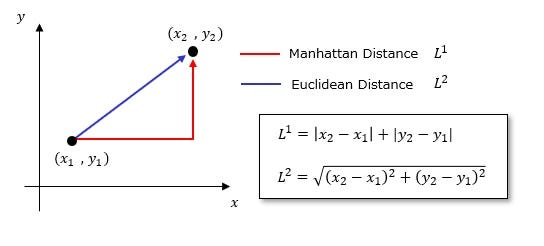
3. Hamming Distance#
Detail |
Description |
|---|---|
Description |
Counts the number of features where two samples differ (mismatches between attribute values). |
Use When |
Data is categorical or binary (e.g., yes/no, text encodings, DNA sequences). |
Caution |
Only works for discrete or categorical features. It gives a binary measure (different or not different) for each feature. |
Formula |
$\(d(\mathbf{x}, \mathbf{y}) = \sum_{i=1}^{n} \mathbb{I}(x_i \neq y_i)\)\( (Where \)\mathbb{I}(\cdot)$ is the indicator function.) |
4. Cosine Similarity#
Detail |
Description |
|---|---|
Description |
Measures the cosine of the angle between two vectors — focuses purely on orientation, not magnitude or size. |
Use When |
Direction matters more than size (e.g., text analysis, where document length shouldn’t bias similarity). Common in recommender systems. |
Caution |
Returns similarity (1 is close, 0 is far) rather than distance. It is often converted to a distance metric as: \(d = 1 - \text{similarity}\). |
Formula |
$\(\text{Similarity}(\mathbf{x}, \mathbf{y}) = \frac{\mathbf{x} \cdot \mathbf{y}}{|\mathbf{x}| |\mathbf{y}|}\)$ |
Weighted KNN#
So far, we have talked about standard KNN, where every one of the k neighbors has an equal vote. Now, we will introduce Weighted K-Nearest Neighbors changes this by giving more weight to the neighbors that are closer to the new data point.
Why? According to Weighted KNN, closer neighbors have a stronger influence on the prediction.
Mathematically, each neighbor is weighted by:
Where:
This means points closer to the query point contribute more to the prediction than distant ones.
In scikit-learn, you can enable this using:
KNeighborsClassifier(n_neighbors=5, weights='distance')
Key Points to remember:
Standard KNN treats all neighbors equally (weights=’uniform’).
Weighted KNN emphasizes closer neighbors, making the classifier more robust to noise.
Works best when your features are continuous numeric values (like Iris measurements).-
Ethics and Responsible ML#
Why Ethics Matter?#
Machine Learning systems influence real-world decisions; from hiring and loan approvals to medical diagnoses and criminal justice assessments. These decisions can significantly affect people’s lives. Therefore, fairness, accountability, and transparency are not optional; they are essential.
Key ethical principles include:
Bias: When training data reflects historical inequalities or social prejudice, models may learn and amplify those patterns.
Fairness: Models should avoid systematically disadvantaging particular groups.
Transparency: Decisions made by models should be explainable and interpretable.
Privacy: Personal data must be handled responsibly and protected from misuse.
Accountability: Organizations deploying ML systems must take responsibility for their outcomes.
Robustness: Models should remain reliable under changing or unexpected conditions.
Human Oversight: High-stakes decisions should include meaningful human review.
Example: A hiring model should not unfairly prefer one gender or racial group due to biased historical hiring data.
Machine Learning systems reflect the data and values embedded in them. Responsible ML requires not only technical skill but also ethical awareness and critical thinking.