How Netflix Knows What You Want?#
It’s Friday night. You open Netflix. You don’t search. You don’t browse much. Yet somehow… the perfect movie is already there. How?
This is the power of Recommender Systems. The Core Idea is that a recommender system tries to answer one simple question:
“What should we show this user next?”
It learns from:
What you watched
What others watched
Patterns across millions of users
What are Recommender Systems?#
Recommender systems are algorithms that predict what a user might like based on data; what they’ve watched, bought, rated, or clicked.
Recommender systems are design to suggest relevant items (e.g., movies, products, songs) to users based on their preferences and behavior.
Netflix, Spotify, and Amazon all use them. A recommender system predicts what a user might like, based on available data. You encounter them daily:
Netflix → “Because you watched Inception…”
Amazon → “Customers who bought this also bought…”
Spotify → “Your Daily Mix”
The core challenge is the “cold start” problem: what do you recommend when you know nothing about a new user or a new item?
Types of Recommender System#
There are two main families of techniques:
content-based filtering (focus on item attributes) and
collaborative filtering (focus on user behavior patterns).
Most production systems combine both.
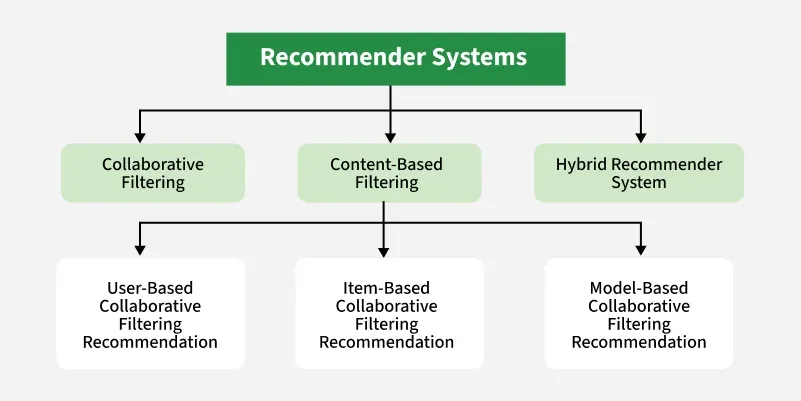
Figure: Overview of a Recommender System. Source: media.geeksforgeeks.org.
Approach |
Key idea |
Data needed |
Key Comparison |
|---|---|---|---|
1. Content-Based |
Recommend items similar to what you liked before |
Item features (genre, cast, etc.) |
User profile vs Item |
2. User-Based CF |
Find users like you, recommend what they liked |
Rating history of all users |
User vs User |
3. Item-Based CF |
Find items similar to ones you rated highly |
Rating history of all users |
Item vs Item |
** CF = Collaborative Filtering